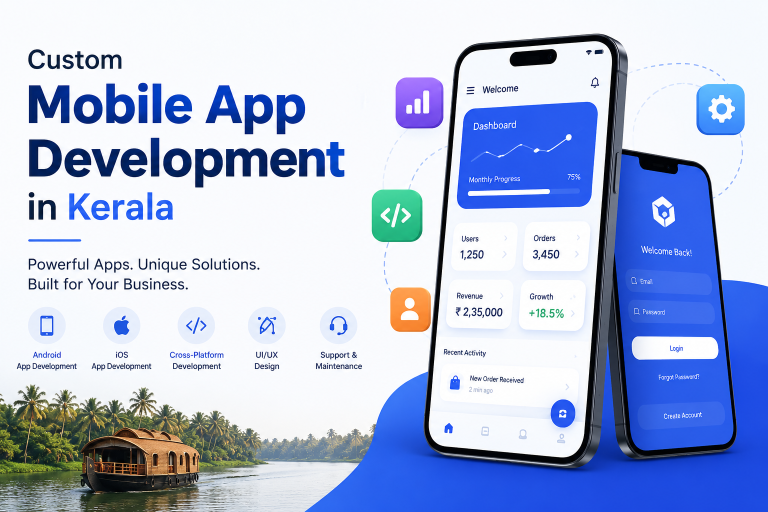
Mobile apps have become an important part of how businesses connect with customers, manage operations, deliver services, and build digital products. From booking platforms and e-commerce applications to business management systems and customer-service apps, organizations across industries are investing in mobile experiences tailored to their specific needs.
Choosing custom mobile app development in Kerala allows businesses to create applications around their unique workflows, customers, brand identity, and long-term goals instead of relying entirely on generic solutions.
A well-designed custom mobile app can provide a more personalized experience, streamline business processes, and create new opportunities for customer engagement.
What Is Custom Mobile App Development?
Custom mobile app development is the process of designing and developing an application specifically for a particular business, product, audience, or use case.
Unlike ready-made applications with fixed features, custom apps can be developed around your requirements.
A custom mobile application may include:
- Customer registration and login
- Online booking
- E-commerce functionality
- Payment integration
- Push notifications
- GPS and location features
- Chat and communication
- User dashboards
- Appointment management
- Inventory management
- Reports and analytics
- API integrations
- Admin panels
- Third-party service integrations
The features depend on the business model and the problems the application needs to solve.
Why Choose Custom Mobile App Development in Kerala?
Kerala has a growing technology and startup ecosystem, along with businesses operating across healthcare, education, tourism, retail, logistics, finance, hospitality, and professional services.
For these businesses, a mobile application can become more than a digital brochure. It can act as a complete platform for customers, employees, partners, or internal operations.
Build Around Your Business
Every business has different processes. Custom development allows the application to reflect those processes instead of forcing your team to adapt to an inflexible system.
Create a Better Customer Experience
An application designed specifically for your audience can provide simpler navigation, personalized content, faster access to services, and convenient communication.
Integrate Existing Systems
Custom applications can be connected with websites, CRM platforms, payment gateways, APIs, databases, ERP systems, and other business tools where technically appropriate.
Scale as Your Business Grows
A properly planned application architecture can accommodate new functionality as your business requirements change.
Custom Mobile App vs. Ready-Made App
Businesses often need to decide between an off-the-shelf application and a custom solution.
A ready-made solution can be useful when your requirements are simple and already supported by existing software.
Custom development may be more appropriate when you need:
- Unique workflows
- Specialized features
- Custom user experiences
- Business-specific integrations
- Advanced automation
- Greater control over the product
- A platform that can evolve with your business
The right choice depends on your requirements, budget, timeline, technical needs, and expected growth.
Types of Mobile Apps Businesses Can Build
A custom development company can create different types of applications depending on the business objective.
E-Commerce Apps
Businesses can create mobile shopping experiences with product catalogues, customer accounts, carts, payments, order tracking, and notifications.
Booking and Appointment Apps
Useful for healthcare, hospitality, salons, professional services, travel, and other appointment-based businesses.
Business Management Apps
Custom applications can help employees manage tasks, records, workflows, approvals, field operations, and reporting.
On-Demand Service Apps
These applications can connect customers with service providers and may include booking, location tracking, payments, notifications, and ratings.
Education Apps
Educational platforms can provide courses, learning materials, assessments, notifications, and student dashboards.
Logistics and Delivery Apps
Businesses can develop applications for order management, driver coordination, location tracking, delivery status, and operational monitoring.
Social and Community Apps
Custom applications can provide communication, content sharing, profiles, communities, and engagement features.
Android and iOS App Development
Businesses targeting mobile users generally need to consider Android, iOS, or both.
Android App Development
Android applications can reach users across a wide range of devices and markets.
iOS App Development
iOS applications provide businesses with an experience designed for Apple’s ecosystem.
Cross-Platform Development
Depending on the project, cross-platform technologies can allow teams to develop applications for multiple platforms using a shared codebase.
The best technology choice depends on factors such as:
- App complexity
- Performance requirements
- Device-specific functionality
- Development budget
- Time to market
- Long-term maintenance
- Existing technology infrastructure
There is no single technology that is ideal for every application.
The Custom Mobile App Development Process
A professional development process should move from business requirements to design, development, testing, deployment, and ongoing improvement.
1. Requirement Analysis
The first step is understanding the business, target users, required features, workflows, and objectives.
2. UX/UI Design
Designers create user flows, wireframes, visual interfaces, and prototypes to establish how the application will look and function.
3. Technology Planning
Developers determine the appropriate architecture, programming technologies, database structure, APIs, integrations, and infrastructure.
4. Development
The application is built according to the approved requirements and design.
5. Testing
Testing helps identify functional problems, usability issues, security concerns, compatibility problems, and performance bottlenecks.
6. Deployment
After testing and approval, the application can be prepared for deployment through the appropriate app distribution channels.
7. Maintenance and Optimization
Post-launch support can include bug fixes, security updates, performance improvements, new features, and compatibility updates.
UX/UI Design Is Critical for Mobile Apps
A mobile application can have powerful functionality but still perform poorly if users struggle to navigate it.
Good mobile UX/UI design should focus on:
- Simple navigation
- Clear visual hierarchy
- Touch-friendly controls
- Consistent design
- Fast interactions
- Readable content
- Accessible interfaces
- Clear error messages
- Useful feedback
- Logical user journeys
The objective is to help users complete tasks with minimal friction.
Security and Data Protection
Security should be considered throughout the development lifecycle rather than added after the application is completed.
Depending on the application, security considerations may include:
- Secure authentication
- Data encryption
- Secure API communication
- Access controls
- Secure payment integration
- Session management
- Regular updates
- Secure data storage
- Vulnerability testing
Applications that process sensitive customer or business information require particular attention to security, privacy, and applicable regulatory requirements.
AI and Modern Mobile Applications
Artificial intelligence is also creating new possibilities for mobile applications.
Depending on the business use case, AI-powered features can include:
- Intelligent search
- Personalized recommendations
- Conversational assistants
- Automated customer support
- Document processing
- Predictive insights
- Content assistance
- Voice-based interactions
AI should be introduced where it provides a meaningful benefit rather than simply being added as a marketing feature.
How Much Does Custom Mobile App Development Cost in Kerala?
There is no fixed price for custom mobile application development because every project has different requirements.
Factors that can affect development cost include:
- Number of platforms
- Number of features
- UI/UX complexity
- Backend requirements
- Third-party integrations
- Payment functionality
- Admin dashboard
- API development
- Security requirements
- Testing requirements
- Maintenance and support
A basic business application and a large marketplace platform can have very different development requirements.
The best approach is to define the project scope and technical requirements before estimating the development budget.
How to Choose a Mobile App Development Company in Kerala
Before selecting a development partner, consider more than the quoted price.
Review the Portfolio
Look for experience with applications similar to your project.
Understand the Development Process
Ask how the company handles requirements, design, development, testing, deployment, and maintenance.
Check Technical Expertise
The development team should understand mobile technologies, APIs, databases, cloud infrastructure, security, and integrations relevant to your project.
Ask About Post-Launch Support
An application requires maintenance after launch. Discuss support, updates, bug fixes, and future development before starting the project.
Focus on Business Outcomes
The application should solve a genuine business or customer problem.
Benefits of Custom Mobile Applications
A well-planned custom application can help businesses:
- Improve customer engagement
- Automate repetitive processes
- Provide convenient digital services
- Improve operational efficiency
- Strengthen brand presence
- Collect useful business insights
- Integrate multiple systems
- Create new digital revenue opportunities
The actual benefits depend on how well the application is designed around the business and its users.
Frequently Asked Questions
What is custom mobile app development?
Custom mobile app development involves creating an application specifically for a business or product based on its unique requirements, users, workflows, and objectives.
How long does it take to develop a custom mobile app?
The timeline depends on the application’s features, complexity, platforms, integrations, design requirements, testing, and approval process.
Should I develop an Android or iOS app first?
The decision depends on your target audience, market, business objectives, budget, and required functionality. Some businesses may benefit from launching on one platform first, while others may require both.
Can a mobile app connect with an existing website?
Yes. Mobile applications can often connect with websites, databases, APIs, CRM systems, payment gateways, and other platforms when the existing infrastructure supports integration.
Can AI be added to a mobile application?
Yes. AI features can be integrated into mobile applications for use cases such as recommendations, chatbots, search, automation, voice interaction, and data analysis.
Conclusion
Custom mobile app development in Kerala gives businesses the opportunity to create digital products around their specific customers, workflows, and objectives.
From e-commerce and booking platforms to business applications and on-demand services, custom mobile apps can support both customer-facing experiences and internal operations.
However, successful app development is not simply about writing code. It requires clear requirements, thoughtful UX/UI design, appropriate technology, secure development, thorough testing, and ongoing optimization.
By choosing the right development approach and focusing on genuine user needs, businesses can build mobile applications that remain useful as their products and customers evolve.